
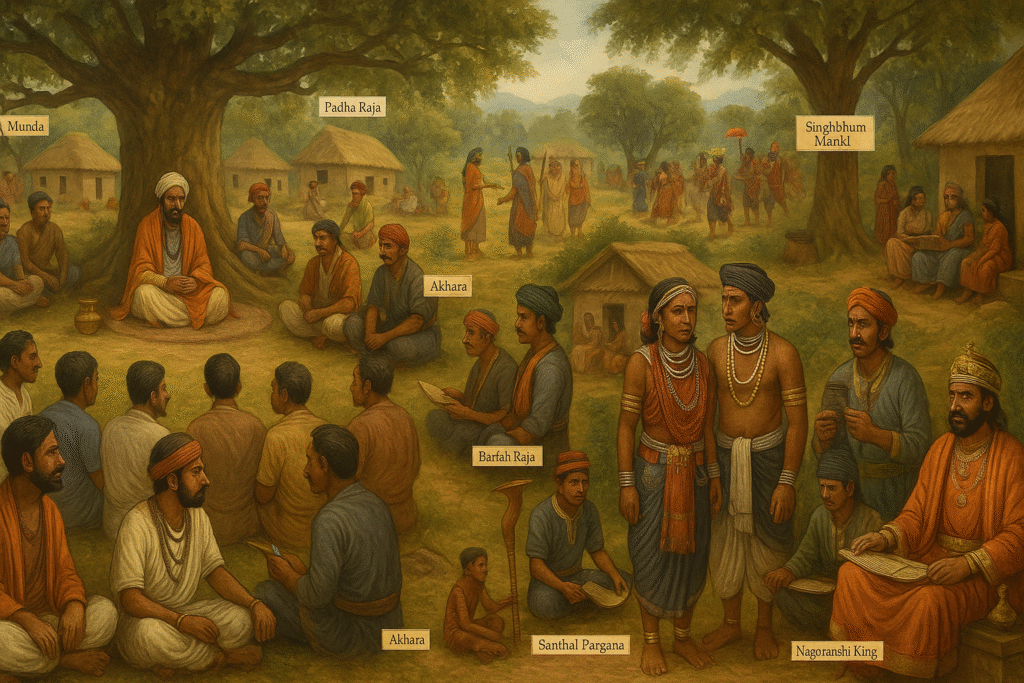
Jharkhand, a land of red soil and dense forests, is home to a wide spectrum of tribal communities—each with its own unique system of self-governance. Long before the modern Panchayati Raj system or colonial administrative structures arrived, these tribes practiced sophisticated indigenous governance based on community consensus, customary laws, and clan-based leadership.
This article offers a comprehensive examination of the traditional governance systems of major tribes like Munda, Santhal, Oraon, Ho, and others, which not only maintained law and order but also preserved ecological balance, resolved disputes, and managed resources equitably.
Self-Governance System of Mundas
- Language: Mundari (Austro-Asiatic Family)
- Main Areas of Residence: Ranchi, Singhbhum, Hazaribagh, Palamu, Dhanbad
- Population: Approximately 12.29 Lakhs
- Main Purpose: Settlement of social, religious, economic, cultural, and criminal matters.
Key Positions and Roles
- Munda: Head of the village; leads administration, judicial functions, and tax collection.
- Padha Raja: Head of a group of 12-20 villages (Padha); handles complex disputes (Honorarium: ₹1000).
- Raja: Head of 22 Padhas; high-level decision-maker.
- Thakur: Assistant to the Padha Raja.
- Diwan: Minister of the Raja; responsible for implementation of orders (Garh Diwan and Raj Diwan).
- Barkandaz (Soldier): Distributes notices; ensures security in Sabha.
- Pandey: Responsible for the protection of documents and issuing notices.
- Lal (Bardalal, Majhalal, Chhotelal): Acts as a lawyer-like debater in Sabha.
- Pahan: Assistant to Munda; oversees religious functions.
- Priest Pahan: Conducts worship during festivals.
- Mahato: Distributes information; assistant to Munda and Pahan.
- Purification Work: Involved in priestly duties.
- Ghatwar: Distributes punishment materials.
- Chawar Dolait: Responsible for washing hands and feet in Sabha.
- Paan Khawas: Distributes lime-tobacco in Sabha.
Dispute Resolution Process
- First Stage:
- The aggrieved person informs the Munda.
- Mahato spreads the information across the village.
- A hearing takes place in the village Sabha.
- Decision: Financial penalty or social boycott.
- Second Stage:
- If unresolved at the village level, a Padha Sabha is convened.
- Information is disseminated through Diwan and Barkandaz.
- Third Stage:
- If unresolved in the Padha Sabha, the matter is taken to the Mahasabha of 22 Padharajas.
- Final Decision: The decision is final and binding.
Contributions of the Traditional System in Various Fields
- Criminal Cases: Economic penalty; decisions based on human values.
- Sexual Atrocities: Strict punishment; responsibility of the girl in case of marriage.
- Development Work: Construction of roads, wells, and canals through Shramdaan (voluntary labor).
- Land Disputes: Fair distribution by Munda.
- Religious Work: Pahan sets the dates for religious activities.
- Rights of Women: Limited rights on land for maintenance.
- Hereditary Rights: The post is handed over only to eligible heirs.
Akhada and Collective Decision Making
- Location: Middle of the village, often under a tree (if available).
- Function: Collective discussion and morality-based decisions; ensures quick and low-cost justice.
Padha Panchayat Governance System (Uraon Tribe)
Village Panchayat
- Main Officials: Mahto (Chief), Pahan (Priest), Bhandari (Messenger).
- Function: Dispute settlement, disaster management, and festival organization.
Padha Panchayat
- Group: 9-12 villages.
- Chief: Padha Raja.
- Other Officials: Diwan, Minister, Kotwar, Panbhara.
- Function: Acts as an appellate court and enforces social rules.
- Special Note: The “Mudma Mela” of Ranchi district is a prominent example of Padha Panchayat’s influence.
Relationship Between Mahto and Padha Raja
- The Mahto works under the Padha Raja.
- The Padha Raja does not intervene without the Mahto’s request.
Manki-Munda Self-Rule System
Historical Background
- Prevalent in western and eastern Singhbhum and Saraikela-Kharsawan districts.
- Prior to British rule, the Porahat (Singhbhum) king ruled, but the ‘Ho’ community was not directly controlled by the king.
Changes After British Rule
- In 1821, the British occupied southern Singhbhum and named it Kolhan Government State. Captain Thomas Wilkinson was appointed in 1837 for administration.
- Wilkinson Rule:
- Munda: Hears civil cases.
- Manki: Hears criminal cases.
Objectives of Administration in Kolhan
- Maintain local governance.
- Establish a direct relationship between the government and the people.
- Settle disputes through village panchayats.
- Prevent the entry of outsiders into the area.
Rights and Duties of Manki
- Hereditary Post (Marusi): Manki’s role is hereditary.
- Chief and Responsible Officer: Oversees the Peed (region).
- Revenue Collection: Works with Munda for revenue collection; entitled to a 10% commission.
- Police Officer: Arrests criminals and hands them over to authorities.
- Government Orders: Acts in accordance with government orders.
- Dispute Resolution: Resolves smaller disputes and reports to the Deputy Commissioner.
Rights and Duties of Munda
- Represents the village and its autonomy.
- Has the right to settle fallow land.
- Informs the government about the settlement of outsiders.
- Oversees public resources in the village.
- Acts as a police officer; reports crimes to district administration.
- Ensures forest conservation and law enforcement.
Other Key Officials in Kolhan
- Manki Committee: Resolves complex disputes.
- Dakuamunda: Assistant to Munda; informs about meetings.
- Tehsildar: Assistant to Manki; handles revenue collection.
- Diuri: Responsible for religious worship and social crime resolution.
- Travel Diuri: Participates in worship of village deities.
Manjhi-Pargana Governance System (Santhal Pargana)
Structure
- Parganait: Head of 15-20 villages.
- Desh Manjhi / Mode Manjhi: Head of 5-8 villages.
- Manjhi: Village head.
- Pranik: Sub-Manjhi.
- Godait: Secretary and Treasurer.
- Jog Manjhi: Youth leadership.
- Jog Pranik: Assistant to Jog Manjhi.
- Bhagdo Praja: Leading member of Gram Sabha.
- Laser Tangoy: Security head.
- Naike: Head of religious functions.
- Chowkidar: Responsible for catching criminals.
Dispute Settlement Process
- Village-Level: Disputes are settled by the Manjhi.
- If Unresolved: The matter is escalated to the Desh Manjhi.
- Final Decision: The Parganait handles unresolved issues at the Parganait level.
Criminal Case Resolution
- Village-Level: Most crimes, except murder, are settled in the village.
- Punishments: Ranges from a light penalty (karela danda) to a large monetary fine.
- Payment Plans: If the criminal cannot pay, they are given a payment period.
- Serious Crimes: No release is allowed for serious crimes.
Settlement of Sexual Crimes
- Reported by the victim or guardian.
- A meeting is held where all parties (complainant, accused, and witness) present their case.
- If Found Guilty:
- A marriage proposal is made (if both parties agree).
- If rejected, an appropriate punishment is imposed.
Additional Traditional Systems
- Illegitimate Children and Marriage Laws:
- Jog Manjhi: Assigned as the gotra for illegitimate children.
- Daughters may be married with the consent of their father, and dowry is provided.
- Family and Village Disputes:
- Disputes are first brought before the village’s Manjhi, and the matter is escalated if unresolved.
- Bitlaha Tradition:
- Social ostracism is imposed if a person does not follow the punishment. The community works together to persuade the individual, and if ignored, a “Bitlaha” ceremony is held.
- Sohor Panchayat (Kharia Tribe):
- Several villages form the Sohor Panchayat to resolve disputes not settled at the village level.
- Village-Level Panchayat System:
- The Mahato and elders lead meetings to resolve disputes, especially related to land and festivals.
- Caste and Private Panchayat System:
- Private Panchayats can be called for personal disputes, where decisions are made through trial by fire or oath.
- Santhal Panchayat System (Manjhi Than):
- Five officers form the Panchayat: Manjhi, Pranik, Jog Manjhi, Jog Pranik, and Godait. Originally elected annually, the position became hereditary.
- Other Tribal Panchayats:
- Other tribes like Bhumij, Chero, Oraon, Munda, Birhor, etc., had their separate panchayats with positions like Mahato, Dehri, Raja, Munda, Naya.
Nagavanshi Governance System
- King: Head of governance.
- Allies: Army, landlords, jagirdars, Brahmins, Rajguru, and priests.
- Revenue Administration: Managed by Diwan, Patwari, and Amin.
- Parha Panchayats: Foundation of administration, though the influence of Kol and Oraon decreased over time, with Kayastha influence growing.