
Note on Jahangir’s Rule and the Struggle of the Nagvanshi Kings
- During Jahangir’s reign, the Mughal Empire became increasingly active in Jharkhand, especially in Chotanagpur and Palamu.
- In 1624, the Mughal army was sent to Chotanagpur but the campaign failed.
- Dhurjan Sal returned in 1627, launched a war with the help of friendly kings against a puppet ruler, and regained his throne.
- Internal conflict among the Nagvanshi clan led some members to leave Kokrah and settle in other regions.
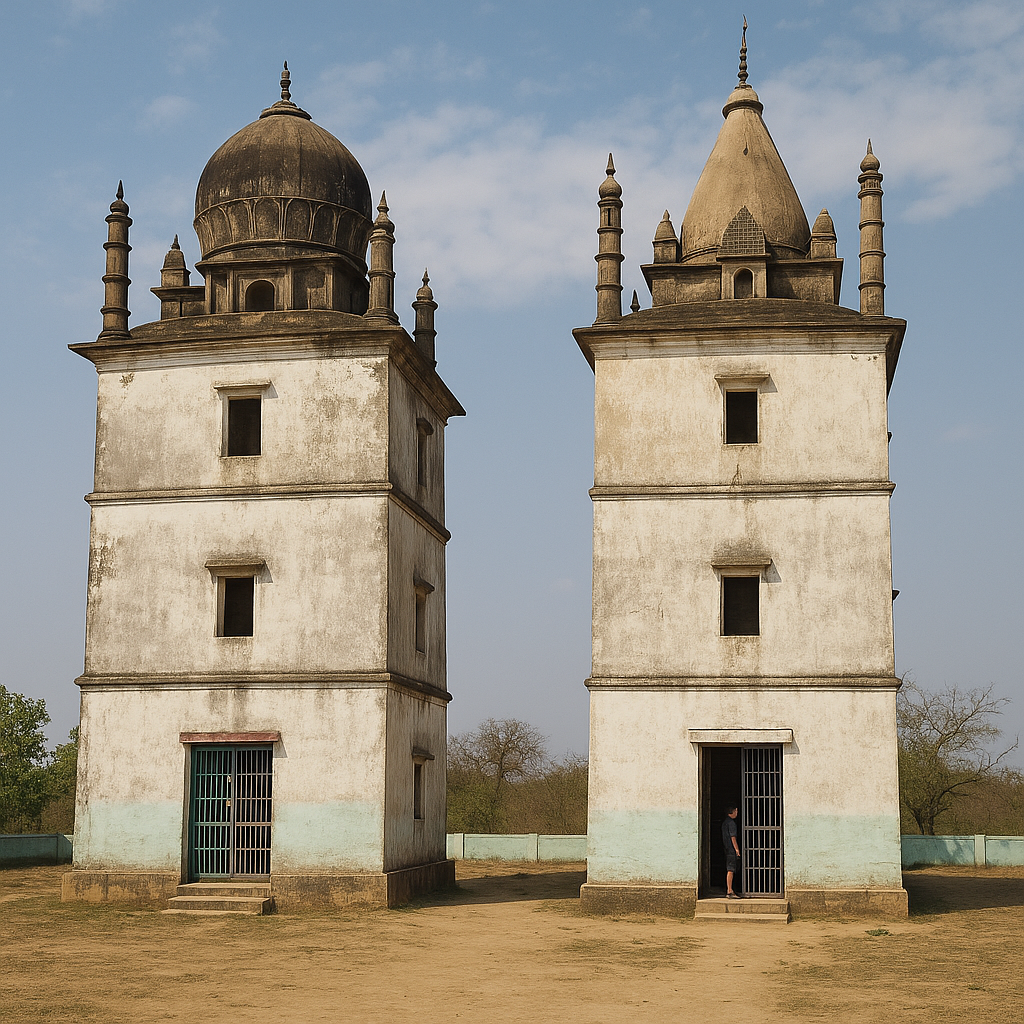
- For military reasons, Dhurjan Sal shifted the capital from Khukhra to Doiysa (now in Sisai block of Gumla district).
- The new capital was naturally fortified: three sides by hills, and one side by the Koel River.
- He built a major palace called Navratangarh at the new capital.
- Dhurjan Sal ruled for 13 years after his return, i.e., until around 1639–40.
- In 1632, Chotanagpur was granted as a jagir to the Subedar of Bihar, with an annual tax of 1,36,000 rupees, increased to 1,61,000 rupees in 1636.
- In Palamu, during Jahangir’s reign, Bhagwat Rai (1585–1605) and Anant Rai (1605–1612) ruled as Cheros.
- According to Mirza Nathan, Anant Rai was ruler of Palamu in the early years of Jahangir’s reign.
- In 1607, Afzal Khan, son of Abul Fazl, was appointed Subedar of Bihar, and Iradat Khan was appointed as Diwan and Bakhshi on 6 September 1607.
- Jahangir ordered an attack on the Chero ruler of Palamu, but the campaign failed due to Afzal Khan’s death within two weeks.
- There are no Muslim sources providing details after Anant Rai’s rule.
- According to Chero tradition, Anant Rai ruled from 1630 to 1661, but this is not corroborated by Muslim chronicles.
- Sahbal Rai (1612–1627) succeeded Anant Rai and was a strong Chero ruler.
- He began harassing traders, prompting Jahangir to send a Mughal force.
- Sahbal Rai was captured and taken to Delhi, where he was forced to fight a tiger for imperial entertainment, which led to his death.
- After Sahbal’s death, Cheros began raiding border Mughal territories, looted a royal treasury boat on the Son River, and re-entered Palamu.
- A new Chero ruler was forced to take refuge near Sasaram at Surwar Rajput landlord Dev Shah’s residence.
- By the end of Jahangir’s reign, Mughal awareness of Chotanagpur increased.
- Dhurjan Sal died in 1639 or 1640; succeeded by Raghunath Shah (1640–1690).
- According to Tavernier, Shah Jahan sent an expedition against Raghunath Shah, but the Nagvanshi king submitted by paying a small tribute.
- As a result, Mughal–Nagvanshi relations improved during the reigns of Shah Jahan and Aurangzeb.
- Raghunath Shah used this peaceful period to construct temples at Doiysa, Chutia, and Boreya.
- During this time, Medini Rai of Palamu attacked Navratangarh and defeated Raghunath Shah.
- The Nagar gate (Nagpuri Gate) of Navratangarh was taken and installed at Palamu Fort.
- The Boreya Temple, built under the supervision of Lakshmi Narayan, began in 1665 and completed in 1682.
- Compared to Nagvanshis, Mughal–Chero relations were less cordial.
- After Sahbal Rai’s death, likely Pratap Rai (1627–1657) took the throne.
- He was the son of Balbhadra Chero, and a powerful ruler.
- Mughals attempted to subdue him but failed.
- Old Palamu Fort was likely constructed during his rule.
- His reign was marked by prosperity in Palamu.
- In 1629, Shah Jahan appointed Ahmad Khan as Subedar of Palamu, granting it as a jagir with 1,36,000 rupees annual tax.
- Due to increased tax demands, Pratap stopped paying and resisted Bihar Subedar Abdullah Khan.
- In 1639, Shaista Khan became Bihar Subedar and informed Shah Jahan of Pratap’s disobedience.
- Shah Jahan ordered a military campaign; on 12 October 1641, Shaista Khan marched toward Palamu.
- On 26 January 1642, Mughal forces entered Aru village, then moved to Cherwan, 4 miles from Palamu Fort.
- Cheros were defeated, and Pratap Rai surrendered, offering 80,000 rupees for pardon.
- Shaista Khan accepted the offer and returned to Patna on 12 February 1642.
- Internal conflicts arose in Palamu after this:
- Pratap’s uncle Tej Rai and Durga (Dariya) Rai plotted to remove him.
- Tej Rai succeeded in seizing power but did not share wealth with Durga Rai.
- Durga Rai contacted the Mughals, offering to hand over Devgan Fort if they helped remove Tej Rai.
- In 1643, Shaista Khan was transferred and Itiqad Khan became the new Subedar of Bihar.
- Tensions escalated:
- Tej Rai sent Madan Singh Thakurai to confront the approaching Mughal general Jabardast Khan.
- Madan Singh lost, and on 5 November 1643, Tej Rai left the fort for a hunting trip.
- Madan Singh’s sons, Surat Singh and Sabal Singh, freed Pratap Rai from captivity and reinstated him as king.
- Pratap Rai offered submission to the Mughals rather than fighting again.
- Jabardast Khan was 6 miles from the fort when he ordered Pratap to come to Patna.
- On 19 November 1643, Pratap Rai left with a war elephant and 1 lakh rupees as tribute to Itiqad Khan.
- In 1644, Shah Jahan granted Pratap Rai the rank of 1,000 mansab and restored Palamu to him.
- Annual tax was fixed at 1 crore dams.
- Pratap remained loyal to the Mughals until at least 1647.
- After his death, Bhupal Rai ruled briefly, followed by Medini Rai (1658–1674).
- Medini Rai took advantage of Mughal internal conflicts and focused on strengthening his state.
- He expanded and fortified Palamu Fort and attacked Doiysa, defeating the Nagvanshi king.
- From the victory, he constructed a smaller fort at Satbarwa in 1634.
- The stone gate from Doiysa was installed at Palamu Fort, called Nagpuri Gate.
- There is no detailed information about Mughal relations with Singhbhum, Dhanbad, or Hazaribagh during Shah Jahan’s reign.
- However, it is confirmed that Kunda Fort was under Mughal control.
- Areas like Chai Champa, Khargdiha, and Ramgarh were not fully subdued.
- Among them, Ramgarh was the most prominent, and it remained under Mughal influence.
- The Raja of Ramgarh was required to provide assistance to Mughals when needed.
- Ramgarh’s capital was originally Baddam, where Raja Hemant Singh built a fort in 1642.
- Under Aurangzeb, the capital shifted 46 km east to Ramgarh.
One thought on “Jahangir’s Rule and the Struggle of the Nagavanshi Kings (1605-1627)”